Monday, May 23, 2016

Project Ara -- Futuristic Modular Android Phone

(5/23/2016) Do you feel it's pretty wasteful to upgrade electronic gadgets sometimes just for "better battery life," "better camera, higher pixels" while most of its functions are fine? Google's Project Ara will try to change it. It's a concept of modular design and allow consumers to 'upgrade' its mobile phone according their individual preferences. If you want a better camera, you buy an high-end camera module; if you want a better audio output, you buy a stereo speakers module (CNET's report). Project Ara is almost the opposite of iPhone's inflexible all-in-one, no-hassle concept.

I believe Project Ara can be a revolutionary game-changer in the mobile phone (maybe all electronic gadget) market. But I really hope Google's Android can have higher integrity in user platform and enhanced security. Without software's integrity, hardware module is just a fad. The video looks very cool, but do you remember the fad of Google Glass?

Watch out, Apple! (However, I still think design integrity in Apple is executed much better than free-spirited Google)

The upfront cost for consumers to customized a modular Android phone can be more expensive (it's like the bill of a-la-carte sushi restaurant, always surprising). But in the long run, it may lead to a more eco-friendly, less wasteful market for electronic products and save $$$ for consumers. There will be less total revenue (and profit) for smartphone manufacturers like Samsung, LG, HTC, ... etc. in the long run if Project Ara is executed right, and they (Samsung, LG, HTC) may eventually be downgraded to "module provider" if lucky. 

Modular upgrade according to consumer's need

Thursday, May 19, 2016

Conscious Innovation - Edible Six-Pack Rings

(5/19/2016) We have seen several pictures showing animal stuck in 6-pack rings. In the future, animals who are stuck with it may be able to rescue itself by chewing the ring. Saltwater Brewery makes the new 6-pack rings from their brewing byproducts (grains) and they are willing to share their innovation with big breweries.
Before animals got stuck for their whole life


Now, they can enjoy a good meal when stuck.

Wednesday, May 18, 2016

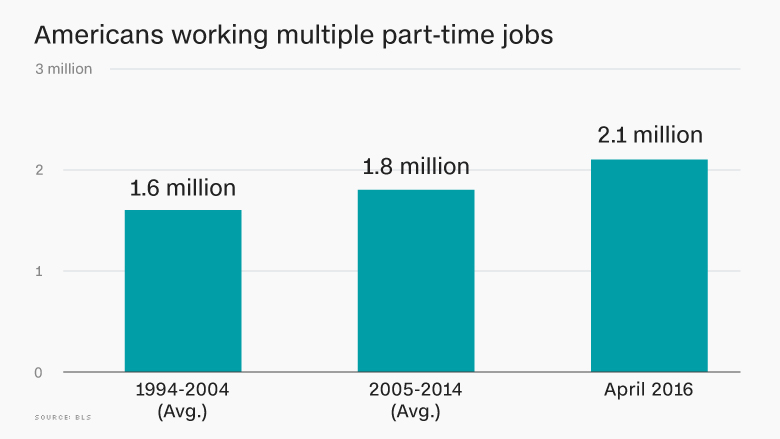
(Not Just A) U.S. problem: I work three part-time jobs

(5/19/2016) This is a common problem in the U.S. and in Taiwan (the country I came from). The low level of labor force is struggling to make their ends meet ( a news from CNN Money). "Part-time work has become a huge worry for experts who watch the U.S. economy. There are 6 million part-time workers who want full-time jobs. It's well above its pre-recession average of about 4 million workers."
      Definitely part of the problem is the greed of capitalists, but part of the problem is that the labor cannot catch up the change of business environments and technology. The speed of changes of technology and business environments is speeding up, like the phenomenon of global warming.
      The integration of computer, information technology, robots has replaced many jobs that are done by labors before. Decades ago, business needed many secretaries, typists, telephone operators, couriers (delivery documents in organizations, please watch the classic movie "Miracle on 34th Street"). Their jobs are way all gone. Now, even the jobs of white collar jobs, machine operators, skilled automobile workers, and delivery men (think about Amazon Drone), or maybe even professional photographer (watch this video) are at risk. The productivity growth from computer, IT and robots outpaces many labors of low ranks. People who have $$$ can invest on firms that provides solutions through computer, IT and robots and enjoy continuous good returns on investment (ROI); but labors who are ignorant of these changes are lagging further and further behind. This is a main cause of current income gap in many countries.
     Before the government can take any effective actions, what we (labors) can do is at least to update our skills and knowledges with technology. However, technology skills and knowledges is not enough. The integration of computer, IT and robots can do a much better, accurate, and faster job and our human brains. We have to be able to be independent thinkers, capable to make good judgements based on our skills and knowledges. At least, in a near future (say, 20 years???), the robots are still not capable to make judgement and think like human beings.

Source: http://money.cnn.com/2016/05/17/news/economy/job-multiple-part-time/


Will automated selfie stick replace some professional photographer's jobs?

Tuesday, May 17, 2016

100-Mile Local Food-Sourcing? Think Again

(5/18/2016) Are you willing to pay more in restaurant for local food sourcing, organic food, or non-GMO ingredient? If so, this article (Farm to Fable-- At Tampa Bay farm-to-table restaurants, you’re being fed fiction) will interest you and make you rethink again. It is an example of investigative journalism, which is very rare in modern days.

Many high-end restaurants claim their ingredients are from local farmers (and they normally charge a premium on that): the pork is from Farmer A, organic salad green is from Farmer B. There are several operational constraints that are too tough to pass.

First, many local farmers are small in scale and cannot afford to hire a professional account manager to handle all restaurants that 'claim' to be their clients. Most of these farmers have their produces handled by one or several distributors. They don't deal with so many restaurants directly.

Second,  if a restaurant claims the ingredients are from more than several dozen's suppliers, the complexity of inbound logistic, paperwork, and account management is way too much for a stand-alone restaurant to handle.

Third, if the restaurant claims ingredients are shipped 'directly' from suppliers, the transportation cost is also very expensive. Food ingredients have to be fresh, so let's assume there are two delivery shipments every week. So how many pounds of pork could a restaurant buy every time? 200 pounds? This volume will be shipped at high cost because the volume is too small. So who is paying the premium in logistics?

Source: http://www.tampabay.com/projects/2016/food/farm-to-fable/restaurants/

Saturday, April 9, 2016

Why A Vacation Home Town Doesn't Want to Be A Vacation Hometown?

(04/09/2016) It is a new about a seaside town in Cornwall is taking on the out-of-towners (those who buy vacation homes there)?
"On May 5th, when the town votes in a referendum on a number of local issues, tucked into the ballot will be a particularly controversial question: whether to make it a legal requirement that all new housing in the area must be for principal residences only. The town expects over 1,000 new homes to be built before 2030. If the measure passes, outsiders will still be able to buy existing properties as second homes, but not new ones."


Why a vacation home town is not good for the vacation home town? I visited a vacation Mecca of New England -- Provincetown, MA several times in the past 7 years. This is what I heard from people living there about the struggle of a vacation home town.
1. Housing prices skyrocketed, natives of the town cannot afford living there anymore.
2. Increase infrastructure spending for the local government, maintaining them is not cheap. Increased property tax does not offset this new spending.
3. Increase peak- and off-season, testing the livelihood of people supporting the town's economy. If you are a plumber, you will be very busy in the peak season, but not many jobs in the off season. How do you hire workers (they will be temporary migrants too because you don't need them in the off-season).
4. Increased rent, make local businesses less sustainable. With demand fluctuation of peak- and off seasons becomes more challenging to maintain business.

I do like the idea of this town -- Cornwall. Making people who buys the home there staying there, keep local economy going healthily all year around.

Provincetown, MA

Monday, April 4, 2016

Warka Water -- Innovative Future Water Solution

(4/4/2016) Some may be aware that water will be a scarce resource on earth. For some countries (like Ethiopia) in Africa, scarce water has been a reality for centuries. Inspired by Warka tree in Ethiopia, designer Arturo Vittori comes up with a solution -- WarkaWater Tower: "a semi-rigid exoskeleton built by tying stalks of juncus or bamboo together and an internal plastic mesh, reminiscent of the bags oranges come in. The nylon and polypropylene fibers act as a scaffold for condensation, and as the droplets of dew form, they follow the mesh into a basin at the base of the structure"


Saturday, April 2, 2016

Tesla Model 3 - A Game Changer for Tesla

(04/02/2016)Looking their pre-order volume, Model 3 will be a game changer for Tesla by achieving economy of scale and cut production cost. In just two days, the pre-order volume has reached 180,000 cars, which is almost 40% of Tesla's new annual production capacity. This analysis says: "With an average selling price of $42,000, that equates to around $7.5 billion."

Elon Musk is not a great speaker like Steve Jobs, but I like him way more. He is the one who takes Jobs' podium now.